
VBET Verification UK: KYC Checks and Withdrawal Readiness
 Available in GB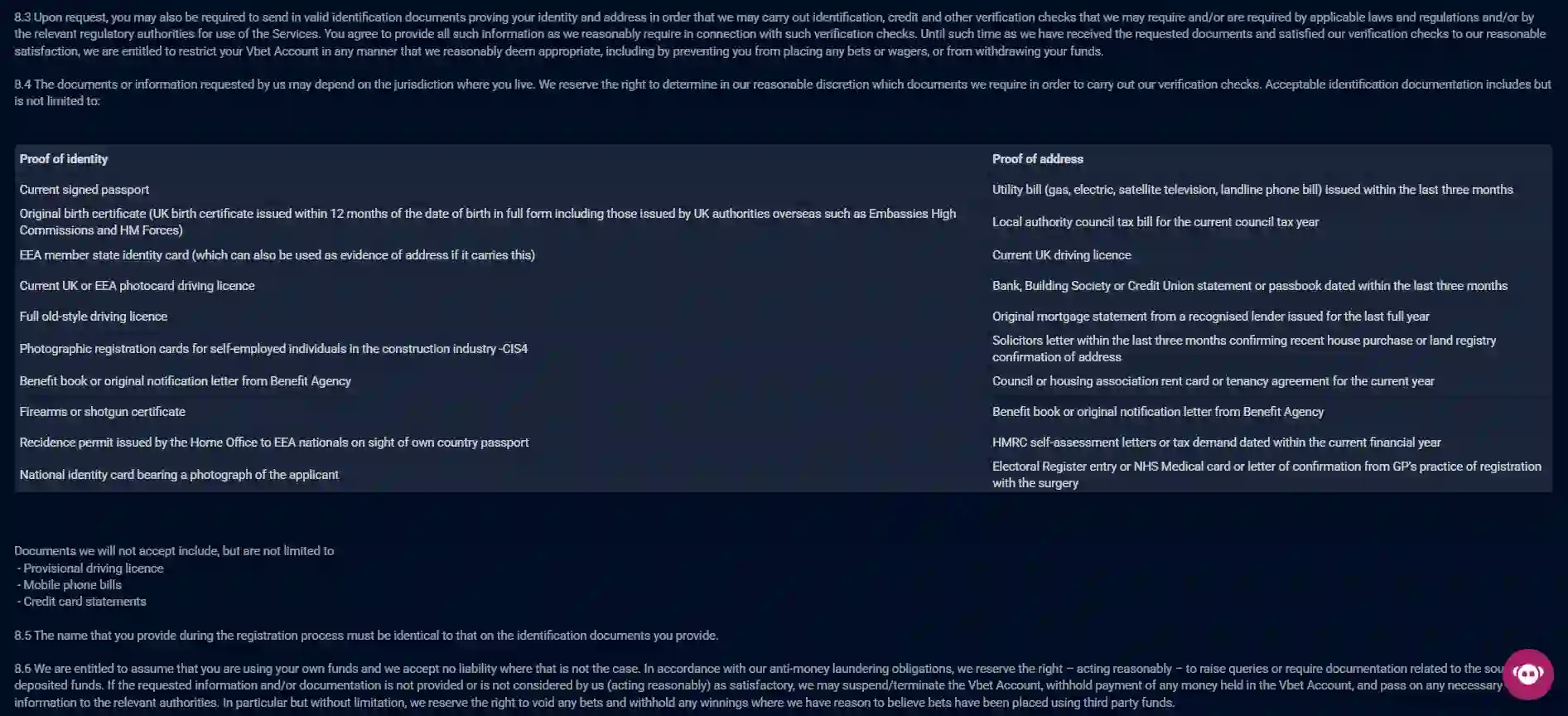
VBET customers in Great Britain should expect identity verification as part of the regulated account process. UK Gambling Commission rules require remote operators to verify a customer’s identity before that person is permitted to gamble, including at least the customer’s name, address and date of birth. VBET-specific checks can go beyond those core data points when further information is lawfully needed. VBET does not publish one universal document list or a single verification time that applies to every account, so customers should follow the request shown in their account.
The practical goal is simple: keep your account details accurate, use payment methods you control, respond through official VBET channels when a legitimate request appears and prepare evidence that supports the information already on your account. Verification should not be treated as a surprise obstacle at cashout. UKGC rules also say a withdrawal request must not trigger an information demand that could reasonably have been made earlier.
Table of Contents
- What VBET verification means
- What the UKGC requires before gambling
- General verification categories you may encounter
- Why verification can still matter at withdrawal
- Pre-withdrawal verification readiness checklist
- Identity KYC and financial-vulnerability checks serve different purposes
- How to respond to a VBET verification request
- What this guide cannot safely promise
- If verification becomes a dispute
- Accurate account data and official channels make KYC easier to manage
- KYC documents, processing time and withdrawal-related checks
What VBET verification means
Verification, often called KYC, is the process of establishing that an account belongs to the person named on it and that key details are credible. For a Great Britain remote gambling account, the regulatory baseline is not merely an email check. Licence Condition 17.1.1 requires remote licensees to establish identity before allowing a customer to gamble, and the information must include name, address and date of birth.
That baseline does not mean every customer receives the same manual request. Some information can be checked electronically. Other situations can require additional evidence because a data match fails, account information changes, a payment raises a question, or another legal obligation requires more scrutiny. The important distinction is between the minimum regulatory purpose and the exact VBET process used for an individual account.
For the broader account journey before and after verification, see the VBET registration guide. This page focuses only on identity checks and preparation.
What the UKGC requires before gambling
The Gambling Commission’s current identity-verification rule is direct: remote licensees must obtain and verify information that establishes the identity of a customer before the customer is permitted to gamble. The regulator identifies name, address and date of birth as minimum identity information. Licensees must also take reasonable steps to keep that information accurate.
Before a customer deposits, the rules say the operator should explain what types of identity documents or other information might be needed, when they might be required and how they should be supplied. That is useful for players because it creates an expectation of transparency before money starts moving through the account.
The rule does not create a universal document checklist for every operator and every customer. It tells operators what they must achieve, while the evidence needed in a specific case can vary. The exact evidence can therefore differ from one account to another. Do not assume that every customer will be asked for the same combination of passport, driving licence, bank statement, selfie, source-of-funds record or other documents; follow the request shown in your VBET account.
General verification categories you may encounter
A useful way to prepare is to think in categories rather than guessing VBET’s live upload list. The following categories describe the kinds of information that regulated gambling businesses can need, not a promise that VBET will request every item from every customer.
| Check category | What it is trying to establish | Practical preparation |
|---|---|---|
| Identity | That the account holder is a real person and the core personal details match | Keep your legal name and date of birth consistent across the account and records you control |
| Address | That the residential address on the account is accurate | Update your account promptly after a genuine move and avoid outdated address data |
| Payment ownership | That deposits or withdrawals are connected to an appropriate account or payment instrument | Use payment methods in your own control and avoid unexplained third-party funding |
| Source or affordability information | Information needed to meet legal, anti-money laundering or safer-gambling duties | Answer legitimate requests accurately and use the operator’s secure official channel |
These categories are deliberately broader than a document list. They help you understand why a request exists without implying that one specific file will always satisfy it.
Why verification can still matter at withdrawal
Identity verification should happen early, but that does not mean every possible check is completed forever after registration. A later withdrawal can coincide with additional questions if new information must be obtained at that time to meet another legal obligation. What the UKGC rule prevents is using withdrawal itself as a reason to demand information that could reasonably have been requested earlier.
The Commission has repeatedly highlighted withdrawal friction as a consumer issue. Its current guidance says businesses cannot ask customers to prove age and identity as a condition of withdrawal when those checks could have been requested earlier. If a business genuinely needs new information for anti-money laundering or another legal duty, it should ask promptly rather than waiting unnecessarily for cashout.
For this reason, verification readiness and withdrawal readiness are closely connected. Before requesting money out, make sure your account details are current, your contact channels work and you can respond to a legitimate request without using an insecure route. The separate withdrawal guide covers cashout mechanics without inventing exact VBET processing times or limits.
Pre-withdrawal verification readiness checklist
- Check the account name. It should reflect your real identity rather than a nickname, abbreviation or another person’s details.
- Check your address. If you have moved, follow the operator’s current process for updating it rather than leaving conflicting records.
- Keep access to your registered email and phone. Losing access can complicate security and verification conversations.
- Use your own payment routes. Avoid creating an unexplained mismatch between account ownership and funding ownership.
- Keep readable evidence available. If VBET asks for a document, follow the live instruction for acceptable type, date range, image quality and upload method.
- Do not crop away required information unless instructed. A file can be rejected if the operator cannot see the fields it asked to verify.
- Protect unnecessary personal data. Only provide what the official request requires and use the official account or support channel.
- Read the reason for the request. Identity, address, payment ownership and other legal checks are not interchangeable.
This checklist cannot guarantee an instant withdrawal. It is designed to remove avoidable mismatches and make any legitimate request easier to answer.
Identity KYC and financial-vulnerability checks serve different purposes
Remote gambling businesses in Great Britain are also subject to light-touch financial vulnerability check requirements. These checks are part of the safer-gambling framework and are not simply another name for identity verification. A customer can have a verified identity and still be subject to a separate financial-risk process where the rules require it.
That distinction matters because a request for more information may have a different purpose from proving who you are. Do not assume every account review means your original identity check failed. Read what VBET is asking for and, if the reason is unclear, ask support to identify the purpose and the secure submission route.
No VBET-specific threshold is stated, and a particular financial check should not be assumed for every customer. Those rules and processes are sensitive to current regulation and individual circumstances.
How to respond to a VBET verification request
- Open VBET through the official UK site or app rather than following an unexpected message link.
- Read the request carefully and identify exactly what information is being requested and why.
- Use the upload route or secure account channel specified by VBET.
- Submit clear, current information that matches the account details where appropriate.
- Keep a record of what you submitted and when, especially if a withdrawal is already pending.
- If the request is unclear, contact support before sending additional sensitive material.
- If a dispute develops, preserve the account messages and relevant transaction history.
Do not send identity documents to an address or messaging account simply because it uses the VBET name. Start from the official service and verify the channel first.
What this guide cannot safely promise
VBET does not publish one fixed document list that applies to every verification case, and there is no single KYC completion time that can be promised for every account. Publishing an old list such as “passport plus utility bill” as if it were a permanent rule would be less useful than explaining how to read the live request.
Verification can depend on what needs to be established and whether electronic checks already succeeded. A customer whose details match cleanly may experience a different process from a customer whose address changed, whose payment ownership needs clarification or whose account triggers another lawful review.
For the same reason, this page makes no “no-KYC” claim and no promise that verification will be completed before a particular hour or withdrawal date. Where timing matters, the current VBET account message is the source that applies to your case.
If verification becomes a dispute
First, separate delay from disagreement. If VBET has asked for information, respond through the proper channel and keep copies of the request and your response. If you believe the operator is repeatedly asking for information that could reasonably have been requested earlier, or is not explaining what remains outstanding, ask for a clear status update and use the formal complaint route when appropriate.
The Gambling Commission register itself tells customers to complain to the gambling business first when they disagree about a gambling transaction or service. A complaint is different from a routine support ticket because it creates a clearer escalation path and record. The VBET complaints guide explains that process and how to preserve evidence.
Do not assume the regulator will resolve an individual balance dispute directly. The useful first step is a documented complaint to the operator, followed by the applicable escalation route if the complaint is not resolved.
Accurate account data and official channels make KYC easier to manage
VBET verification should be treated as a normal part of a regulated Great Britain gambling account. The safe facts are that remote operators must verify core identity information before gambling and that VBET can require account verification in relevant circumstances. What cannot be safely universalised is the exact document bundle or a fixed completion time.
Prepare by keeping your account data accurate, using your own payment methods, maintaining access to registered contact details and answering legitimate requests through official channels. That approach is more useful than memorising an outdated KYC checklist. For the wider operator and regulatory context, return to the full VBET UK review.
KYC documents, processing time and withdrawal-related checks
Does VBET require verification in the UK?
Yes. Account verification can be required, and UKGC rules require remote operators in Great Britain to verify core customer identity information before allowing gambling.
What documents does VBET ask for?
VBET does not publish one universal document list for every account. Follow the live request shown in your account.
How long does VBET verification take?
No fixed VBET processing time is claimed here. The time can depend on the check required and whether additional information is needed.
Can VBET ask for more information when I withdraw?
It can request information that is genuinely required at that time for another legal obligation, but UKGC rules say a withdrawal should not trigger information that could reasonably have been requested earlier.
What should I do if verification delays a withdrawal?
Respond through official channels, keep records of requests and submissions, ask what remains outstanding and use VBET’s formal complaint route if the issue is not resolved.
Written by the editors at Vbet Casino.