VBET Complaints UK: Reviews, Disputes and Escalation Steps
 Available in GB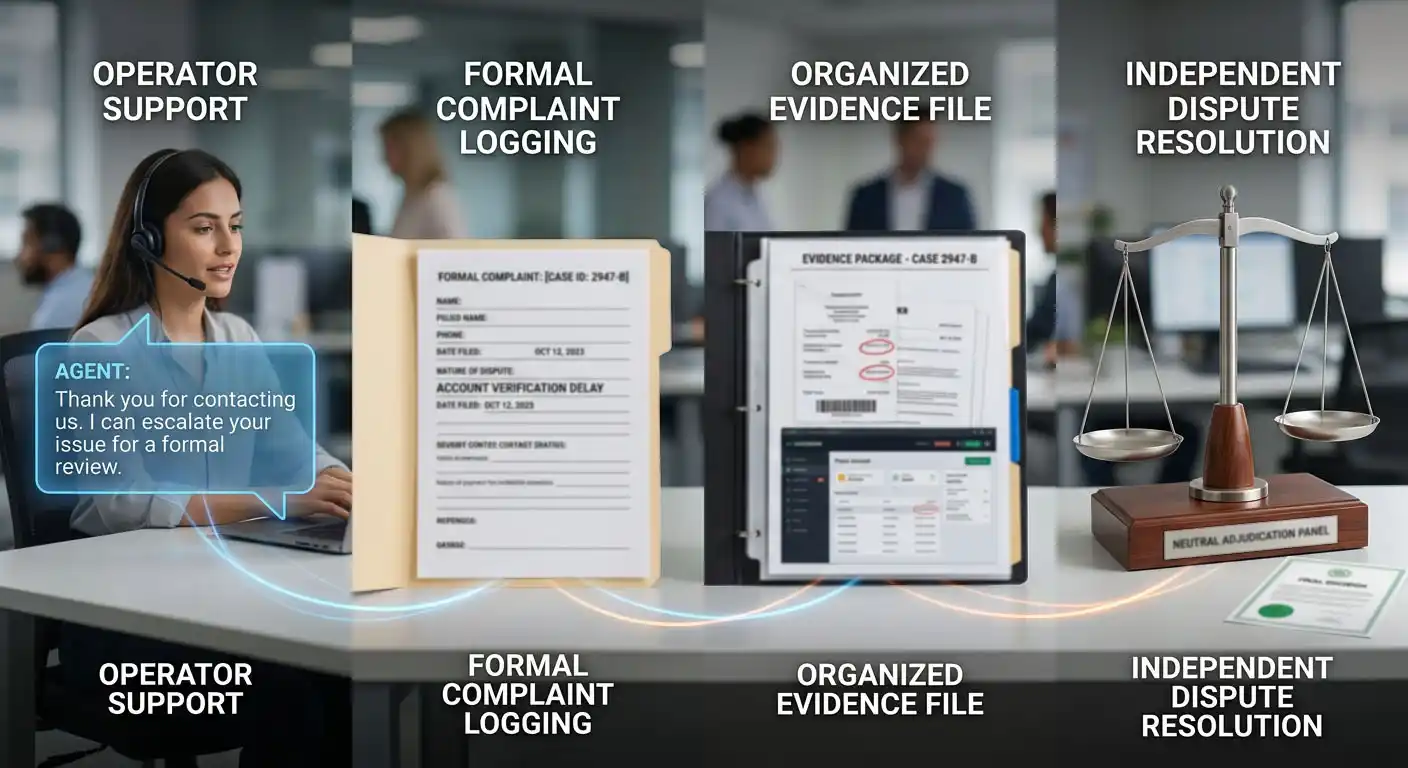
VBET complaints need to be read in two different ways. Public review sites show customer sentiment, but individual reviews are allegations and experiences, not regulatory findings. The firmer reference point for Great Britain is the Gambling Commission register, which lists SCGO Limited account 44662, the VBET trading name and active VBET UK domains. If you have your own dispute, the useful route is procedural: raise it with VBET first, describe the issue precisely, preserve every relevant record, and follow the operator’s formal complaints process. A licensed gambling business has up to eight weeks to complete that process. If the dispute is still unresolved, or the operator reaches a final position sooner, you may be able to take it to the approved Alternative Dispute Resolution provider identified by the operator.
A crowd score is not proof that VBET is good, bad, fair or unfair. Public reviews are most useful for spotting recurring themes, while a genuine dispute should be documented and assessed on its own evidence.
Table of Contents
- What current VBET reviews actually tell you
- Reputation evidence: a practical hierarchy
- How to complain to VBET step by step
- Evidence checklist before you escalate
- When ADR becomes relevant
- Common complaint types and how to frame them
- What not to do with negative reviews
- Strong evidence, the internal process and ADR are the practical route
- Review evidence, complaint timing, ADR and records to keep
What current VBET reviews actually tell you
Independent review platforms are useful as an early-warning source, but they are not a substitute for evidence. Current public review data shows that VBET’s UK Trustpilot profile is heavily negative and recent posts repeatedly discuss support experiences, promotions, account checks and withdrawals. That is a real reputation signal. It does not establish that every allegation is accurate, that a game is unfair, that a payment was wrongly withheld, or that the operator breached a licence condition in a particular case.
There are several reasons to treat the pattern carefully. People with a smooth transaction have less reason to post than people with an unresolved problem. Reviews can refer to different countries, products, account histories and verification circumstances. A post may omit information the operator cannot disclose publicly. Conversely, a low score should not simply be dismissed: repeated complaints about the same process can tell you where to pay extra attention before depositing or requesting a withdrawal.
The best use of review data is therefore diagnostic. If many users mention verification, read the VBET verification guide and keep account information consistent. If withdrawals are a recurring concern, read the VBET withdrawals guide and understand the difference between payment processing and an unresolved account check. If reviews focus on promotional confusion, keep the exact offer terms that applied when you opted in. The review tells you what to document, not what conclusion to reach automatically.
Reputation evidence: a practical hierarchy
| Evidence | What it can establish | What it cannot establish by itself |
|---|---|---|
| UK Gambling Commission register | Licensed operator identity, trading name and registered domains for Great Britain | Whether your individual complaint should succeed |
| VBET account records and correspondence | What happened in your own case, including dates, requests and responses | How other customers were treated |
| Formal complaint decision | VBET’s stated position on the disputed issue | An independent final ruling |
| ADR decision | An independent assessment of an eligible unresolved transaction dispute | A general rating of the whole casino |
| Public review platforms | Patterns in customer sentiment and recurring topics worth checking | Regulatory breach, fraud, game manipulation or the facts of your case |
This hierarchy matters because a complaint is easier to resolve when it is framed around a specific transaction, term or account action rather than around a general reputation label. The VBET UK licence confirms the regulatory identity of the Great Britain operation; it should not be confused with an endorsement of every customer-service outcome.
How to complain to VBET step by step
- Define the issue. State what happened, when it happened and what outcome you want. Examples include a disputed settlement, a missing promotional entitlement, a withdrawal status that has not been explained, or a verification decision you believe was handled incorrectly.
- Contact VBET through an official support channel. The UK support channels include live chat, email and phone, and the recorded UK support email is [email protected]. If the first contact does not resolve the matter, make clear that you want the issue handled as a formal complaint.
- Send the evidence once, clearly organised. Include dates, times, amounts, transaction or bet identifiers, screen captures, relevant terms and the key correspondence. Avoid sending a long narrative without the records that support it.
- Keep a copy of everything. Save the original complaint, attachments, chat transcripts, emails and every response. Record the date the formal complaint was received because the regulatory complaints timetable runs from receipt.
- Follow internal escalation. VBET may have more than one internal stage. Ask for the current status if a response does not make clear whether the complaint remains open or has reached a final position.
- Request the ADR route when appropriate. The Gambling Commission requires licensed operators to provide access to an approved ADR provider for eligible unresolved disputes. The operator should tell you which provider is relevant and how to contact it.
The Commission’s current guidance says the entire operator complaints process must take eight weeks or less. A business can reach deadlock earlier. When the internal process ends, the customer should receive written confirmation of the outcome and information on escalation to ADR if the dispute remains unresolved.
Evidence checklist before you escalate
- Your VBET username or account identifier, but not your password.
- The date and approximate time of the disputed event.
- Deposit, withdrawal, bet or game transaction identifiers where available.
- The amount involved and the account balance before and after the event if relevant.
- Screen captures showing the status, message or terms at issue.
- The promotion terms or rules that were displayed when you accepted an offer.
- Copies of verification requests and the dates you responded, with unnecessary personal data redacted when sharing outside the secure operator channel.
- Chat transcripts and email threads, kept in chronological order.
- A short statement of the remedy you are asking for.
For a withdrawal complaint, record whether the money has merely remained pending, whether VBET has asked for verification, or whether the operator has actually issued a final refusal. Those are different states. For a KYC dispute, record exactly what information was requested and when rather than assuming that any document request is improper.
When ADR becomes relevant
Alternative Dispute Resolution is designed for disputes about gambling transactions or the service connected with them after the operator’s own complaints process has been used. The current Gambling Commission guidance describes ADR as a free, independent service for customers. You normally cannot bypass the gambling business and go directly to ADR before using its complaint procedure.
The operator should identify the approved ADR provider that applies to your dispute. No VBET-specific ADR provider is named because that relationship can change and current official VBET material did not provide sufficiently reliable confirmation. Use the provider stated in VBET’s current final response or complaints information rather than an old forum post or affiliate page.
ADR is also different from complaining to the Gambling Commission. The Commission regulates operators and can use intelligence about compliance, but it does not function as the individual adjudicator for every customer balance dispute. If your aim is to resolve a specific transaction, the operator complaint and applicable ADR route are the practical path.
Common complaint types and how to frame them
Withdrawal or cashout dispute
Give the withdrawal request date, amount, method, status history and any verification requests that followed. Avoid claiming that a delay proves wrongdoing. The useful question is whether the operator has explained the reason and whether the account process is progressing consistently with its obligations.
Verification dispute
Record the information VBET requested, the secure channel used to submit it, the submission date and any further request. UK regulation allows identity and other legally required checks, so the complaint should focus on the actual handling: repeated requests, unclear status, a disputed decision or information that you believe could reasonably have been requested earlier.
Promotion dispute
Save the promotion page and terms that applied at the time, including eligibility, qualifying play and any expiry. Do not rely on a current marketing page to prove what an older offer said. From 19 January 2026, Great Britain licensed operators are also subject to a 10x cap on wagering requirements applied to bonus funds and a prohibition on mixing more than one gambling product type in a single incentive.
Game or settlement dispute
Record the exact game or market, time, stake, round or bet identifier and settlement shown. A losing streak or an unexpected result is not evidence that a game was manipulated. A useful complaint identifies a specific rules or settlement issue that can be checked against records.
What not to do with negative reviews
Do not copy another customer’s allegation into your complaint as if it proves your own case. Do not describe VBET as fraudulent merely because a public reviewer uses that word. Do not assume a low public rating overrides the UKGC register, and do not assume the licence means a complainant must be wrong. These are different evidence categories.
A stronger approach is to ask: does the review describe a process risk I can prepare for? If yes, preserve the relevant terms and records before the problem arises. That turns reputation checks into practical due diligence instead of a contest between marketing claims and angry comments.
Strong evidence, the internal process and ADR are the practical route
VBET’s current public review profile contains substantial negative sentiment, with recurring complaints around support, promotions, verification and withdrawals. Treat those as signals to document carefully, not as proven findings about individual transactions. For Great Britain, VBET remains tied in the regulator’s current register to SCGO Limited account 44662, with active VBET trading and domain records.
If you have a real dispute, the decisive material is your own evidence trail. Contact VBET, make the complaint formal, keep records, allow the internal process to run, and use the approved ADR route given by the operator if the matter remains unresolved. For the broader assessment of games, payments, mobile access and regulatory identity, return to the full VBET UK review.
Review evidence, complaint timing, ADR and records to keep
Are VBET reviews reliable?
They are useful for measuring sentiment and spotting recurring complaint themes, but individual reviews are not regulatory findings and should not be treated as proof of misconduct.
How long can a gambling complaint take?
For a Great Britain licensed gambling business, the entire internal complaints process must take no more than eight weeks from receipt, although a final or deadlock position can be reached sooner.
Can I go straight to ADR?
Normally no. The Gambling Commission says you must first go through the gambling business’s own complaints procedure. If the dispute remains unresolved, the operator should identify the relevant approved ADR provider.
Does the Gambling Commission resolve my individual VBET dispute?
The Commission regulates licensed businesses, but the standard route for an individual transaction dispute is the operator’s complaint process followed, where eligible, by the applicable ADR provider.
What should I save before complaining?
Keep transaction identifiers, dates, amounts, screen captures, terms, verification requests and complete chat or email correspondence. A chronological evidence file is more useful than a general accusation.
Created by the ”Vbet Casino” editorial team.